


What role will AI and Automation in Industry 4.0 play in shaping the future of manufacturing and production? The integration of artificial intelligence in Industry 4.0 is changing how businesses work. It makes them more efficient and productive. As companies use AI and automation, they see big improvements in their operations.
Industry 4.0 is all about using more artificial intelligence, robotics, and automation. This change helps businesses stay ahead and adapt to new market trends. AI and Automation in Industry 4.0 help companies make their processes better, cut costs, and improve product quality.
Introduction to Industry 4.0
Industry 4.0 is the fourth industrial revolution. It’s marked by the use of digital technologies like artificial intelligence, robotics, and the Internet of Things (IoT). This revolution is changing how businesses work, making them more agile and responsive to customer needs.
Key Takeaways
- AI and Automation in Industry 4.0 are transforming the manufacturing and production landscape
- Artificial intelligence is driving efficiency and productivity gains in Industry 4.0
- Companies that adopt AI and automation technologies are experiencing significant improvements in their operations
- Industry 4.0 is characterized by the increasing use of digital technologies, including AI, robotics, and IoT
- The integration of AI and automation in Industry 4.0 is enabling businesses to optimize their processes and reduce costs
- AI and Automation in Industry 4.0 are enabling companies to improve product quality and responsiveness to customer needs
Understanding Industry 4.0: The Fourth Industrial Revolution
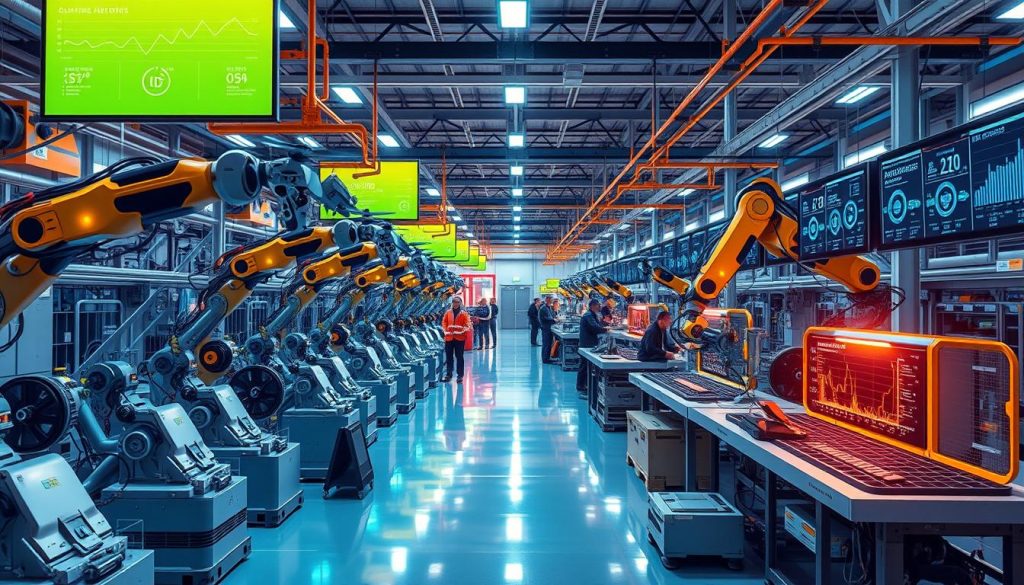
Industry 4.0, also known as the Fourth Industrial Revolution, is a big change in how we make things. It uses industrial automation and smart factories with new tech like artificial intelligence, robotics, and the Internet of Things (IoT).
This revolution makes making things more efficient, productive, and flexible. Some of the good things about Industry 4.0 include:
- Improved product quality and consistency
- Reduced production costs and increased competitiveness
- Enhanced customer experience and satisfaction
Industry 4.0 is changing the manufacturing world. It lets companies make high-quality products cheaper and more efficiently. As industrial automation and smart factories grow, we’ll see big changes in how products are made and delivered.
| Industry 4.0 Technologies | Benefits |
|---|---|
| Artificial Intelligence (AI) | Improved product quality and consistency |
| Robotics | Increased efficiency and productivity |
| Internet of Things (IoT) | Enhanced customer experience and satisfaction |
The Impact of AI on Manufacturing Processes
Artificial intelligence is changing the manufacturing world. It makes processes more efficient and productive. Now, manufacturers use machine learning to better their production, predict when things need fixing, and make products better. This move to AI helps companies keep up with the fast-changing market.
Some key benefits of AI in manufacturing include:
- Improved predictive maintenance, reducing downtime and increasing overall equipment effectiveness
- Enhanced quality control, using machine learning to detect defects and anomalies in real-time
- Optimized production planning, using data analytics to streamline processes and minimize waste
AI is also making smart factories a reality. By combining AI with IoT sensors and devices, factories become more efficient and adaptable. This setup allows for real-time monitoring, automated decisions, and ongoing improvement of how things are made.
Enhanced Efficiency and Productivity
AI-powered systems in manufacturing can handle huge amounts of data. This gives insights into how things are made. It helps find where things can be better, use resources wisely, and boost productivity. By adopting digital transformation and machine learning, manufacturers can lead the way and see big improvements in efficiency and productivity.
Automation Technologies Revolutionizing Industry
Automation is changing the way industries work. Robotics and Internet of Things (IoT) are key players in this change. They make processes more efficient and cut costs.
The use of IoT and smart devices boosts automation’s power. It lets industries watch and control their processes in real-time. This leads to better products, less downtime, and more efficiency. 

Key Benefits of Automation Technologies
- Improved efficiency and productivity
- Enhanced product quality and consistency
- Reduced costs and increased competitiveness
- Real-time monitoring and control of industrial processes
Cyber-physical systems are also making a big impact. They mix physical and digital parts to make systems more efficient and flexible. Robotics, IoT, and cyber-physical systems are driving change in many industries.
| Technology | Benefits |
|---|---|
| Robotics | Improved efficiency, increased productivity |
| IoT Integration | Real-time monitoring, improved product quality |
| Cyber-Physical Systems | Increased efficiency, adaptive systems |
AI Algorithms Transforming Industrial Operations
AI algorithms are changing how industries work. They make things more efficient, productive, and help make better decisions. In Industry 4.0, AI and automation are leading this change. They help with predictive maintenance and make production better.
Thanks to machine learning and deep learning, industries can look at lots of data. They can spot patterns and make smart choices. For example, machine learning can predict when equipment might fail. This lets industries fix things before they break, saving time and money.
Machine Learning in Production Lines
Machine learning can make production lines work better. It helps reduce mistakes and improve product quality. By looking at data from sensors and machines, industries can find ways to get better. They can then make changes to be more efficient.
Deep Learning Applications in Industry
Deep learning, like neural networks, can handle complex data. This includes images, videos, and sounds. It helps industries find oddities, sort products, and predict when things need fixing. This leads to better maintenance and lower costs.
By using AI and automation in Industry 4.0, industries can grow and innovate. They can also be more productive and efficient. This is thanks to predictive maintenance and other AI uses.
Benefits of AI and Automation in Business
Artificial intelligence and industrial automation are changing the business world. They offer many benefits. One key advantage is saving money and using resources better. AI and automation help companies work more efficiently, cut down on waste, and boost productivity.
For example, AI can predict when machines might break down. This prevents costly downtime. It also helps companies save money.
Another big plus is making products better and more consistent. Automation helps companies make high-quality products with little variation. AI looks at data to find ways to improve even more. This makes customers happier and more loyal.
AI also helps businesses make better decisions. It gives insights that guide decision-making. This keeps companies competitive.
- Increased efficiency and productivity
- Enhanced product quality and consistency
- Improved decision-making capabilities
- Cost reduction and resource optimization
As more companies use AI and automation, they’ll see big improvements. They’ll work better and make more money. Using AI and automation helps businesses stay ahead and succeed in the long run.
| Benefits | Description |
|---|---|
| Cost Reduction | AI and automation help reduce costs by optimizing resources and streamlining operations |
| Improved Product Quality | Industrial automation enables consistent production, while AI analyzes data to identify areas for improvement |
| Enhanced Decision-Making | AI-driven analytics provide insights that inform decision-making, enabling businesses to make data-driven decisions |
Challenges and Considerations in Implementation
Companies starting their digital transformation face many challenges. One big worry is how automation will affect jobs. But, it also opens up new chances for workers to learn new skills.
Keeping data safe and private is another big challenge. With more IoT devices and sensors, the risk of cyber attacks grows. Companies need strong security to protect their data and keep it safe from hackers.
Workforce Impact and Job Displacement
- Automation might replace some jobs, but it also brings new chances for workers to learn skills like maintenance and programming.
- Companies should invest in training their workers to use AI and automation.
- Managing the change from old ways to new ones is key. Companies need to explain the benefits and listen to concerns.
Data Security and Privacy Issues
To tackle data security and privacy, companies can use strong security steps like encryption and access controls. Regular security checks and risk assessments help spot weak spots.
By knowing the challenges and thinking about them, companies can do better in their digital transformation. This way, they can make sure their journey is successful.
| Challenge | Consideration | Solution |
|---|---|---|
| Workforce impact | Job displacement | Upskilling and reskilling |
| Data security | Cyber attacks | Robust security measures |
| Change management | Communicating benefits | Change management strategies |
Real-World Examples of AI and Automation
Many companies are using machine learning and robotics to make their work better. For example, Siemens and General Electric are predicting when equipment might fail. They also plan maintenance better with machine learning.
Here are some examples of AI and automation in different fields:
- Manufacturing: Tesla and Volkswagen are using robots to make their products better and faster.
- Healthcare: Hospitals are using AI to look at medical images and find diseases sooner.
- Logistics: Amazon and UPS are using robots to make their warehouses work better and get packages delivered faster.
These examples show how AI and automation can change many industries for the better. As technology gets better, we’ll see even more cool uses of machine learning and robotics.
| Company | Industry | Application of AI and Automation |
|---|---|---|
| Siemens | Manufacturing | Predictive maintenance using machine learning |
| Tesla | Automotive | Robotics in production lines |
| Amazon | Logistics | Automation of warehouses using robotics |
Future Trends in AI and Automation
The future of AI and automation is changing fast. Big steps are expected in the next decade. The Internet of Things (IoT) will be key in changing how we work.
Predictive maintenance, a big part of IoT, will help industries work better. It will help them cut down on downtime.
Predictions for the Next Decade
AI and automation will be everywhere in industries soon. They will make things more efficient and productive. IoT devices will help monitor and analyze industrial processes.
Emerging Technologies on the Horizon
New technologies like edge computing and 5G networks will speed up AI and automation. They will make data processing and transmission quicker. This means we can analyze lots of data right away.
Some big trends to look out for include:
- More use of IoT devices for predictive maintenance
- Edge computing for quicker data processing
- AI and automation working with new tech like 5G networks
The Human Element in Automation
AI and Automation in Industry 4.0 are changing the industrial world. It’s important to remember the role of people in this change. Artificial intelligence is not just about machines; it’s also about the people working with them.
The success of AI and automation depends on reskilling the workforce. We need to teach workers new skills like critical thinking and problem-solving. Training programs can help workers use their skills with machines and AI.
Collaboration Between Humans and Machines
Working together is key in an automated world. Humans and machines can use their strengths to improve work. For example,
Creating a Culture of Innovation
Staying competitive in an automated world means being innovative. This means trying new things, learning from mistakes, and welcoming new ideas. A culture of innovation helps unlock AI and automation’s full potential.
The human element is crucial for AI and automation’s success in Industry 4.0. By focusing on human skills, teamwork, and innovation, companies can use AI to their advantage. This way, they can stay ahead in the competitive world.
Conclusion: Embracing AI and Automation
The use of industrial automation and smart factories is changing the way we make things. It’s making factories smarter and more efficient. This change is key for businesses to stay ahead in today’s fast-paced world.
The Path Forward for Industries
Companies that use AI and automation will see big benefits. They’ll save money, make better decisions, and improve their products. By using cyber-physical systems and machine learning, they can work smarter and outdo their rivals.
Key Takeaways for Businesses
Businesses need to invest in digital tools and train their workers. They should also encourage new ideas and technology. By doing this, they can overcome challenges and grow with AI and automation.
Call to Action for Stakeholders
Now is the time for everyone to get on board with industrial automation and smart factories. By following the advice in this article, businesses can start their digital journey. This will help them thrive in the future of manufacturing.